How to price Etsy products for real profit
Learn how to price Etsy products after materials, labour, shipping, seller fees, discounts and Offsite Ads, with a simple worked example.
A sticker sheet costs $2.50 to make and $4.20 to ship. At a selling price of $7.99, it leaves about eight cents after standard U.S. listing, transaction and payment-processing fees. If the order carries a 15% Offsite Ads fee, it loses about $1.12.
That price may look reasonable: it is more than three times the production cost. But production cost is only one part of the sale.
Etsy shows the fees on an order, but not what you paid for materials, how long the product took to make or what you spent on packaging. You have to put those numbers together yourself.
Start with the full cost of one order
Write down everything you pay to make and deliver one item:
- Materials or supplier costs
- Packaging and inserts
- Labour
- Shipping paid by you
- Any per-order design, software or replacement allowance
Labour belongs in the calculation even if you are not paying an employee. If a product takes 30 minutes to make and your hourly rate is $30, it carries $15 of labour.
Digital products have costs too. Design time, purchased graphics, software and customer support all take money or time.
Add the seller fees
Etsy currently publishes a $0.20 USD listing fee and a 6.5% transaction fee. The transaction fee generally applies to the listing price plus any amount charged for shipping and gift wrapping. You can check the details in Etsy's Fees and Payments Policy.
Payment processing is separate. The rate includes a percentage and a fixed amount, and it varies by country. The current U.S. rate is 3% plus $0.25 per order. Etsy lists the rates for each country on its payment-processing fee page.
Some sellers also pay a regulatory operating fee. VAT, taxes and currency conversion can change the final amount shown in the payment account.
Fixed fees matter most on inexpensive products. Under the U.S. assumptions above, the $0.20 listing fee and $0.25 processing charge total $0.45. That is 5.6% of a $7.99 sale, but only 1.6% of a $27.99 sale.
Use a formula instead of doubling the cost
Start by checking the profit on a price:
Then calculate the margin:
For a normal sale, excluding taxes and optional or capped fees, you can estimate a price for a target margin with this simplified formula:
Suppose a ceramic mug costs $7.50 to produce and $4.55 to ship. The total product and shipping cost is $12.05. Using the U.S. assumptions above and a 45% target margin:
Rounded to a clean selling price, that becomes $27.99. Doubling the $7.50 production cost would have produced a $15 price and ignored shipping, fixed fees and the target margin.
At $27.99, the estimated results are:
- Profit per normal sale: $12.83
- Profit margin: 46%
- Estimated profit at 30 sales: $384.93
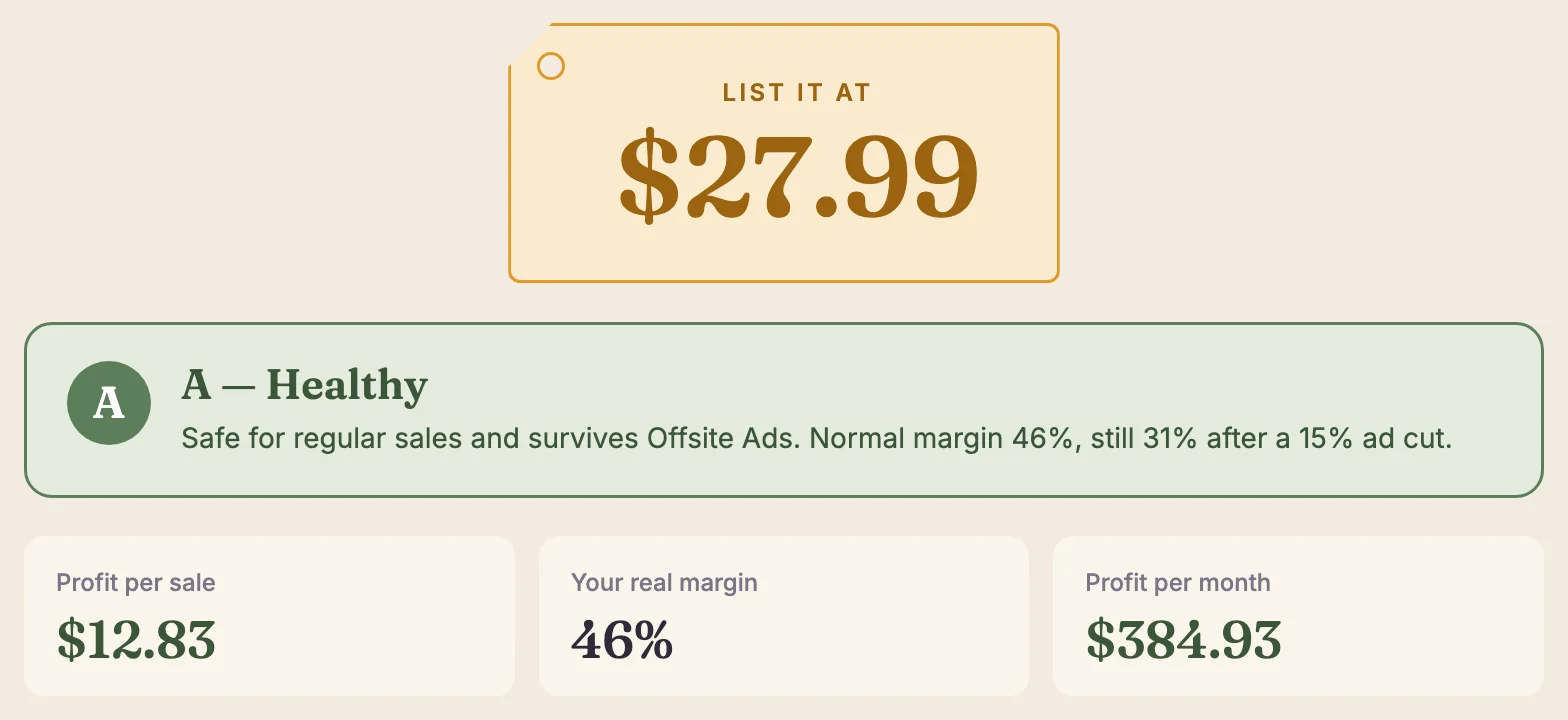
The point is not that every mug should sell for $27.99, but that the price was tested against this mug's costs and fee assumptions.
Check Offsite Ads and discounts
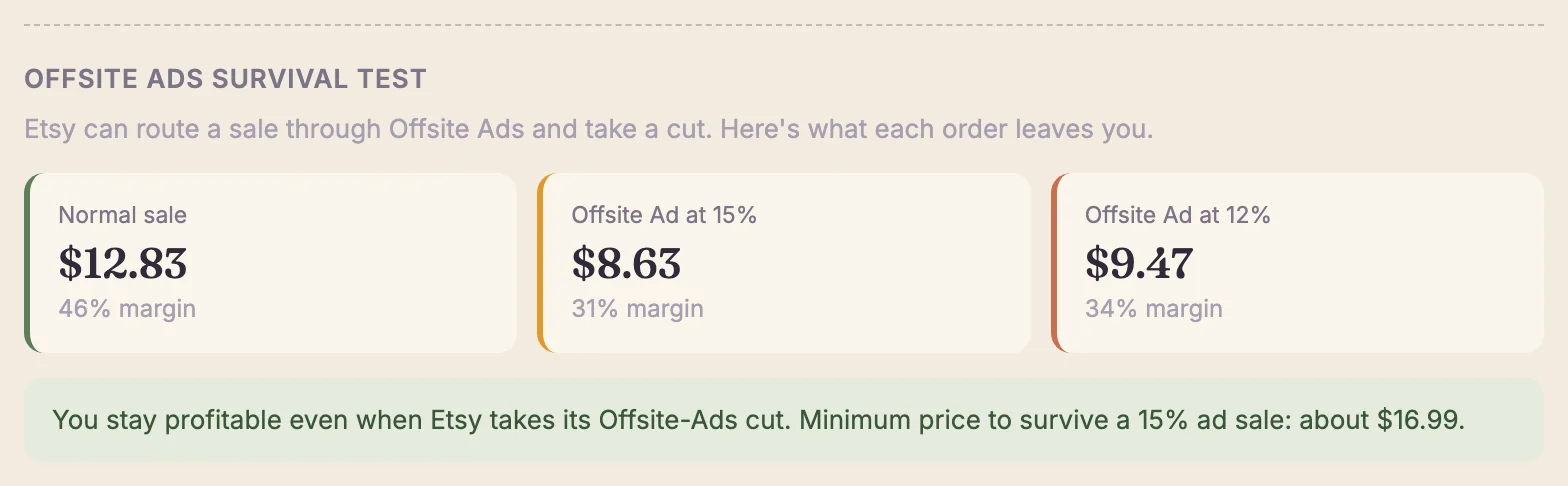
An order attributed to Etsy Offsite Ads may carry an additional advertising fee. Etsy currently uses a 15% rate for qualifying shops below its sales threshold and a 12% rate for shops that have reached the threshold. Participation rules also depend on the shop's sales history. Etsy explains the rules on its Offsite Ads help page.
For the $27.99 mug, estimated profit changes to $8.63 with a 15% Offsite Ads fee and $9.47 with a 12% fee. The order still makes money, but a 15% attributed sale gives up about a third of the profit.
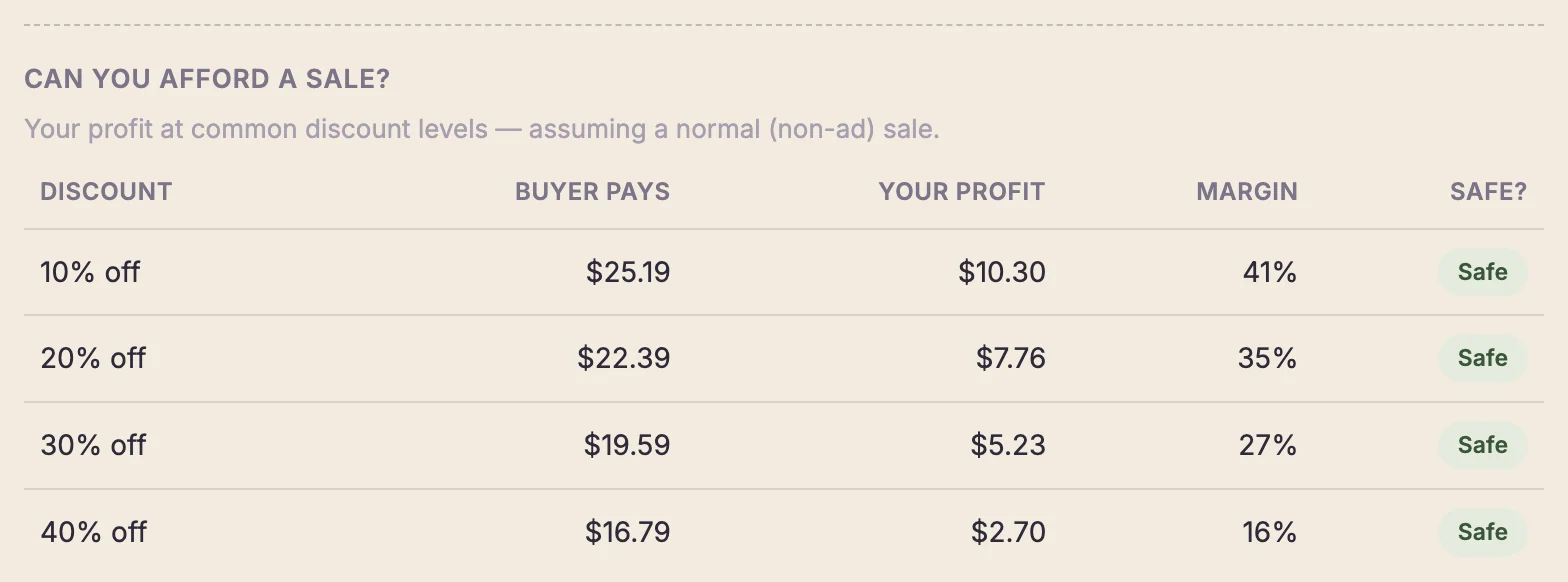
Discounts have the same problem. At 10% off, the mug earns an estimated $10.30. At 20% off, it earns $7.76. A 30% discount leaves $5.23, and a 40% discount leaves $2.70.
The sticker sheet from the opening has almost no room to absorb either charge. It earns about $0.08 on a normal sale and loses about $1.12 on a 15% attributed order. One such loss equals the profit from roughly fourteen normal sales.
Under the same assumptions, its exact break-even price on a 15% attributed order is about $9.47. Rounded to the calculator's next .99 price, that becomes $9.99, which leaves a margin of about 4% on such an order. At $11.99 that margin is about 16%.
Review prices when costs change
Recheck a listing when postage rises, a supplier changes its price, Etsy changes a fee or you plan a sale. Use the same currency for every input. Changing a currency symbol does not convert the values.
Doing this by hand is manageable for a few products. Repeating it across a full catalogue is where mistakes creep in.
The Pricing & Profit Calculator for Etsy Sellers runs this calculation with your own costs and editable fee assumptions. It suggests a price from your target margin, then scores it against the Offsite Ads and discount cases above. The included workbook does the same for up to 248 listings.
Start with one of your lowest-priced products and one bestseller, and enter the real cost of each order. If the margin is thin, you will know whether to raise the price, lower the cost or stop discounting.
Fees and policies can change. Compare estimates with your current Etsy Shop Manager and payment statement. Figures shown use U.S. fee assumptions for illustration and are estimates, not tax, accounting or financial advice.
Etsy is a trademark of Etsy, Inc. This article and toolkit are not affiliated with, endorsed by or sponsored by Etsy, Inc.